Core promise · schema
Mortgage website schema markup, done properly — see it live.
Every page carries a connected graph of structured data, generated from the same data that renders it. Open the explorer below: it reads this very page's JSON-LD.
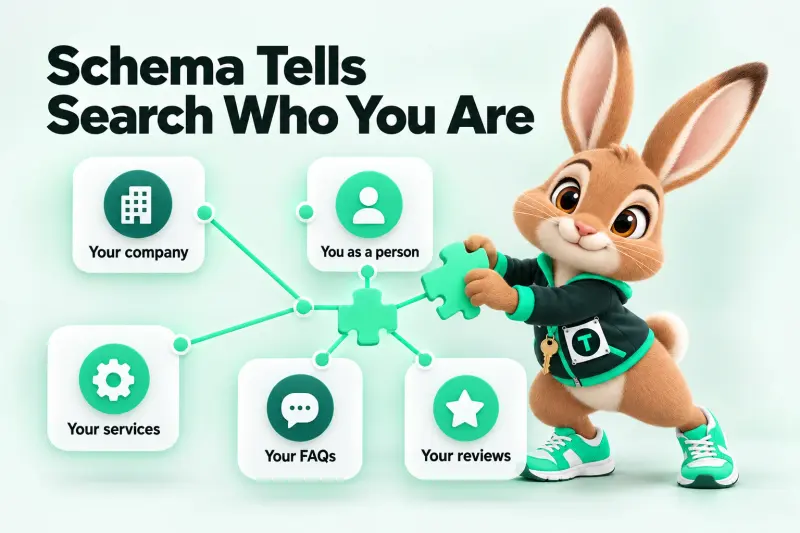
Schema explorer: this page's graph
Select an entity to see its JSON-LD.
Types we use
Which schema types does a mortgage site need?
The eight below cover nearly every page. Read Google's structured data introduction for the rules.
| Type | Where | Describes |
|---|---|---|
| Organization / FinancialService-style company data | Every page | Who the business is, contact points, logo, area served |
| Person | Bio and author pages | The loan officer: name, role, NMLS ID (as an identifier), employer |
| Service + Offer | Product and pricing pages | What's offered and, where shown, the price |
| FAQPage | Any page with visible FAQs | The questions and answers on that page |
| BreadcrumbList | Every page below home | Where the page sits in the site |
| HowTo | Process pages | Steps such as a launch or application process |
| Article / BlogPosting | Guides and posts | Headline, author, dates, publisher |
| WebSite + SearchAction | Home | The site name and its search |
FAQ
Schema questions
What is schema markup on a mortgage website?
Schema markup is structured data (usually JSON-LD) in a page's code that tells search engines, in a standard vocabulary from schema.org, what the page is about: the company, the loan officer, the services, the FAQs. It doesn't change what visitors see.
Which schema types should a loan officer site use?
Organization (or a financial-service style organization), Person for each LO, Service, FAQPage on pages with visible FAQs, BreadcrumbList, HowTo for process pages and Article for guides — all connected in one @graph.
Does schema improve rankings?
Google says structured data helps it understand pages and can make them eligible for certain rich results; it isn't a direct ranking boost. It also helps AI systems connect facts to the right entity.
Should reviews be marked up with schema?
Only genuine reviews you have the right to show, under Google's rules. Our own site shows sample testimonials, so it deliberately has no Review or AggregateRating schema.
Where does your schema come from?
From the same data files that render the page (company, pricing, authors, FAQs), so the markup always matches what's visible.
How can I check a page's schema?
Use Google's Rich Results Test or the Schema.org validator on any URL, or open the explorer on this page, which reads this page's own JSON-LD.
Is the NMLS ID part of the schema?
Yes, as an identifier on the Person and Organization where appropriate — plus visibly on the page, because schema must reflect visible content.
Launch day in 5 business days
Data search engines can trust.
Schema ships with every page we build.
No payment on the form · Monthly plans cancel any time · Reply within 4 business hours