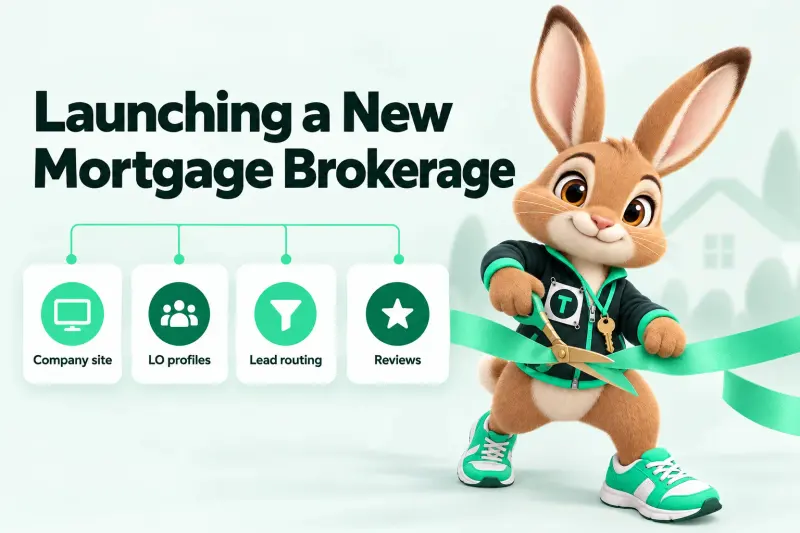
Key takeaways
- Set up in licensing order: company NMLS record, state licenses, then the site — publish only what's approved.
- One company site with a profile per LO beats separate LO sites for compliance, search and lead visibility.
- Decide lead routing rules before launch: by state license first, then language, source and round-robin.
- Company Google Business Profile, a consistent reviews routine and an always-on answer for calls come next.
- Budget the first year in one table so nothing surprises you.
Opening a brokerage is a hundred tasks at once: entity paperwork, the company NMLS record, state licenses, wholesale lender approvals, an office or a service area, and the first loan officers. Marketing tends to get squeezed into whatever’s left. This plan puts it in a sensible order so your website and marketing are ready the day you can legally use them — and not a day before.
What order should you set things up in?
Licensing first, marketing second. You can draft privately at any time, but nothing should go public until the matching license is real.
| Step | Owner | What becomes possible |
|---|---|---|
| 1. Company formed, company NMLS record created | Broker-owner | Private drafting of the site |
| 2. First state company license approved | Broker-owner | Publish the site for that state |
| 3. LOs sponsored and active | Each LO | Their profiles go live |
| 4. Lead routing rules agreed | Broker-owner + LOs | Forms and applications switch on |
| 5. Company Google Business Profile | Broker-owner | Local search visibility |
| 6. Reviews routine and answering | Team | Social proof and no missed calls |
Under the SAFE Act framework, both the company and each individual originator are licensed or registered through NMLS, and both identifiers belong in your advertising. Borrowers can verify them on NMLS Consumer Access.
One company site or a site per loan officer?
Two structures
One company site + LO profiles
Best for most new brokerages
- One compliance review
- Search authority builds on one domain
- Owner sees every lead
- LOs have profiles, not full personal sites
Separate site per LO
Possible later
- Strong personal brands
- Compliance review per site
- Authority split across domains
- Sites leave when LOs leave
Start with one site. Add personal sites later for LOs who earn them.
What goes on each LO profile?
- Photo and a bio in the LO’s own words
- The LO’s individual NMLS ID and the states they’re licensed in
- Specialties and languages
- Reviews collected for that LO on the company’s profile
- A personal booking link and an application link that route to them
How should you route leads?
Routing is where most new brokerages lose leads. Agree the rules before launch and put them in the CRM:
- State license first. A lead in a state goes only to LOs licensed there. Out-of-state leads get flagged, not assigned.
- Language. If a borrower prefers Spanish, route to your Spanish-speaking LO.
- Source. A partner’s referral link always goes to that partner’s LO.
- Round-robin for everything else, so new LOs get fair chances.
- Speed rule. Every assignment triggers an alert; unacknowledged leads escalate to the owner.
How routing rules narrow 50 new leadsIllustrative example
Show data table
| Rule | Leads |
|---|---|
| New leads this month | 50 |
| In a licensed state | 46 |
| Matched to a language preference | 46 |
| Assigned within 5 minutes | 46 |
Explaining the broker model
Borrowers often don’t know what a broker does. Your home page should say it plainly: the brokerage compares options from the wholesale lenders it’s approved with, and the borrower chooses with the trade-offs explained. Two cautions:
- Don’t name lenders you aren’t approved with, and be careful naming any — approvals change and lenders have their own brand rules.
- Don’t promise better pricing. Explain choice, not guaranteed savings.
If you add jumbo program pages, explain jumbo relative to the conforming loan limit, which the FHFA updates every year:
Link to FHFA’s figures rather than hard-coding them across many pages — that number changes every year.
Google Business Profile, reviews and answering
Company Google Business Profile
Set it up once the company has a real address or service area. Keep the business name, address and phone exactly the same on the website, the profile and every directory listing.
A reviews routine
Ask every closed borrower, consistently, with a one-tap link to the company profile, and show each review with the LO’s name. Never buy, fake or gate reviews — the FTC’s rule (16 CFR Part 465) covers all three.
Answering every call
New brokerages are thinly staffed. An AI receptionist or a shared answering line keeps the company number covered while everyone’s in meetings, and books time on the right LO’s calendar.
Co-marketing with agents
Before you build co-branded pages or share ad spend with real estate agents, talk to your compliance lead about RESPA Section 8, which restricts things of value exchanged for referrals of settlement services.
What does the first year cost?
Here’s one example built only from our published prices, for a three-LO brokerage on yearly billing with Google profile setup, a logo kit and the all-channel AI Engine:
First-year marketing stack for a 3-LO brokerage (our prices)
Show data table
| Item | Own Shop (yearly billing) | Google Business Profile setup | Logo mini-kit | All-channel AI Engine (12 mo) |
|---|---|---|---|---|
| Year 1 | $2,340 | $129 | $189 | $3,597 |
| Item | Price |
|---|---|
| Own Shop (5 LO profiles) | $229/mo (yearly billing is cheaper) |
| Extra LO profile | $19/mo each |
| Google Business Profile setup | included in Own Shop; $129 one-time otherwise |
| Logo mini-kit | $189 one-time |
| All-channel AI Engine | $279/mo + $249 one-time setup |
Your numbers will differ. The point is to see the whole year on one page before you commit to anything.
Should a new brokerage have a recruiting page?
Often, yes. Growing brokerages recruit, and loan officers research brokerages the same way borrowers research LOs. A “Join the team” page should be factual: what kind of loan officers you’re looking for, how the brokerage supports them, which states you’re licensed in, and how to start a confidential conversation. Avoid income claims you can’t support, and route these enquiries to the owner only — not into the borrower pipeline.
Brand basics for a new brokerage
You don’t need a big brand project in month one. You do need consistency:
| Element | Month-one standard |
|---|---|
| Name | Exactly as licensed, written the same way everywhere |
| Logo | A simple mark that works small (favicon, social avatar) |
| Colors | Two or three, used consistently |
| Voice | Plain, specific, no superlatives |
| Disclosures | Company NMLS ID and licenses in one standard block |
| Photos | Real photos of your team and your area |
Consistency matters for search too: search engines and AI assistants connect information about a business more confidently when its name, address and identifiers match across sources.
Month one, week by week
Week 1 — foundation. Company site live for approved states, LO profiles for sponsored LOs, routing rules in the CRM, and phones covered.
Week 2 — visibility. Company Google Business Profile created, directory listings claimed and made consistent, LO email signatures and social bios updated.
Week 3 — relationships. Each LO sends a personal introduction to the partners they’re allowed to contact, with their own profile link.
Week 4 — routines. Reviews requests switched on, weekly lead-review meeting started, and a short list of the questions borrowers asked most (your first content topics).
What to measure from the start
| Metric | Why | Review |
|---|---|---|
| Leads by source | Where to invest | Weekly |
| Time to first contact, by LO | Speed wins conversations | Weekly |
| Leads by state | Licensing priorities | Monthly |
| Reviews collected per LO | Social proof growth | Monthly |
| Missed calls | Coverage gaps | Weekly |
Keep it simple. Five numbers reviewed every week beat a dashboard nobody opens.
Choosing a domain for the brokerage
Pick the domain before anything else is printed. Three rules keep it simple:
- Match the licensed name as closely as you can, so borrowers and regulators connect the two.
- Register it in the company’s name, on an account the owner controls — not a former employer’s, not a designer’s personal account.
- Keep it short and spellable. You’ll say it on the phone, print it on signs and type it into every profile. Avoid hyphens and creative spellings.
Then reserve matching social handles and use the same name format on your Google Business Profile and directories. That consistency is what lets search engines — and AI assistants — confidently connect your company’s website, profiles and reviews as one business.
The month-one checklist
- Company NMLS record and first state license confirmed
- Site drafted privately; published only for approved states
- Company NMLS ID and licenses on every page
- A profile per LO with their NMLS ID and states
- Routing rules written down and set in the CRM
- Company Google Business Profile created and verified
- Reviews routine switched on for every LO
- Phones covered, with handoff and alerts
- Co-marketing plans reviewed for RESPA
- Every approval saved
A brokerage’s first month is chaos. The website shouldn’t be part of it.

Written by
Maren Holt, Launch Editor
Maren writes our launch guides: what a new or moving loan officer needs live on day one, and in what order.
Editorial persona — GetsMortgageNow launch desk · Writes from our build checklists and onboarding notes
Sources
- FHFA — Conforming loan limit values for 2026 — announced Nov 2025
- CFPB — Regulation H (SAFE Act), 12 CFR Part 1008
- NMLS Consumer Access
- CFPB — RESPA (Regulation X)
- eCFR — 16 CFR Part 465 (consumer reviews and testimonials)
Educational content, not legal, compliance or financial advice. GetsMortgageNow is not a lender.
 What a mortgage website costs (and what you get)
 AI receptionists for loan officers: what they can (and must not) say
 Mortgage advertising compliance for loan officers